
What Boxing Training is Right for Boxers
- Ravi Deol

- Apr 6
- 3 min read
Updated: Apr 10
Boxing strength and conditioning is not about copying gym methods. It’s about applying what actually transfers to performance.
After reviewing my programming, I made a clear decision:
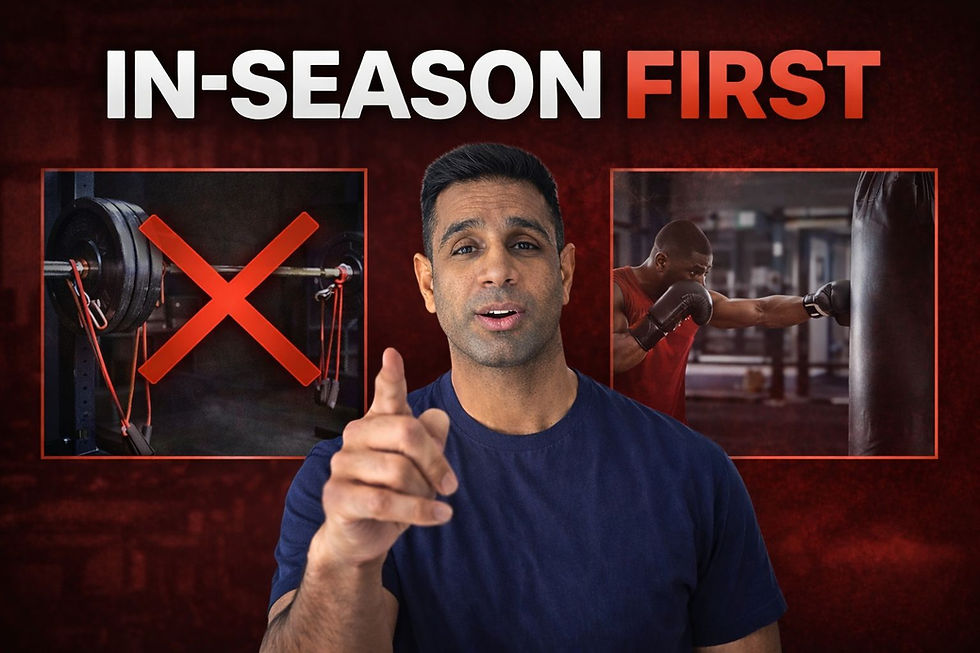
I removed the traditional dynamic effort phase completely from my boxing training system.
Not because explosive training isn’t important but because in boxing it should already be built into the entire program.
This is already developed through lifting weights, boxing drills, plyometrics and med-ball throws.
The traditional dynamic effort method, using bands and chains for speed strength becomes unnecessary and less specific to boxing performance that's why its programmed for speed strength in the off-season.
If you’re following a structured boxing strength and conditioning program, this shift becomes even more important for long-term development.
🥊 What Is Dynamic Effort Training in Boxing Strength and Conditioning?
Dynamic effort training is typically used to improve speed and rate of force development.
It usually involves:
Lifting lighter loads at high velocity
Moving weights with maximum intent
Separating speed-focused sessions from strength work
This approach is common in powerlifting systems — but boxing is a completely different sport.
⚠️ The Problem With Using a Separate Dynamic Effort Phase
In boxing strength and conditioning, separating speed into its own phase creates a disconnect.
Boxing performance requires:
Strength
Speed
Coordination
Timing
👉🏾 All working together — not in isolation.
When dynamic effort is left until the end of a block, it becomes:
❌ Too late
❌ Too isolated
❌ Less transferable
To understand how boxing-specific conditioning should actually be structured, it’s important to focus on how energy systems are trained in real fight scenarios.
👉🏾 (Insert internal link: Boxing Conditioning blog)
🔥 Why I Removed Dynamic Effort From My Boxing Program
The decision came down to one key principle:
👉🏾 Boxing is explosive from the start — so training should be too.
Instead of waiting to “add speed later,” I prioritise:
Explosive intent in every session
Fast, reactive movements from the warm-up onwards
Continuous exposure to velocity-based work
This approach aligns closely with how a proper boxing warm-up routine should prepare the body for performance — not just increase heart rate.
👉🏾 (Insert internal link: Boxing Warm-Up blog)
🥊 How I Replace It | Bands and Explosive Warm-Ups
Rather than using a separate dynamic phase, I integrate explosive work throughout the session.
🔹 Band-Resisted Movements
Banded punches
Banded push work
Resistance-based speed drills
👉🏾 Bands allow acceleration through full range — which better matches punching mechanics.
🔹 Explosive Warm-Ups
Med ball throws
Jump variations
Reactive drills
👉🏾 The warm-up becomes a performance primer — not just preparation.
🔹 Strength Paired With Speed
Strength exercises combined with explosive movements
Focus on intent, not just load
👉🏾 This bridges the gap between gym strength and boxing performance.
This also connects directly to how core stability plays a role in transferring force efficiently during punches.
👉🏾 (Insert internal link: Boxing Core Training blog — planks / anti-rotation)
🧠 Why This Approach Works Better for Boxing
This system aligns with how boxing is actually performed:
Explosive actions happen repeatedly
Speed and strength are never separated
Movement is reactive and coordinated
By integrating explosive work throughout:
✅ Better transfer to punching power
✅ Improved conditioning carryover
✅ More efficient programming
🥊 Boxing Strength and Conditioning Should Be Integrated
The biggest mistake in boxing strength and conditioning is treating qualities separately.
Instead of:
Strength phase
Then speed phase
👉🏾 We build both together.
This creates athletes who are not just strong — but effective in the ring.
If you want to see how this fits into a full system, refer back to the complete program structure.
👉🏾 (Insert internal link: Boxing Strength and Conditioning Program page)
Final Thoughts
Removing dynamic effort wasn’t about doing less.
It was about doing better.
👉🏾 More specific
👉🏾 More integrated
👉🏾 More aligned with boxing performance
That’s the standard at RJ Boxing S & C.
👊🏾 Train With Purpose
If you want a structured boxing strength and conditioning program built for real performance:
👉🏾 Check out the full program on the website 👇🏾💪🏾
TRAIN HARD, FIGHT EASY 👊🏾💪🏾

Comments